Home Employee Onboarding

Employee Onboarding Made Simpler for Growing Companies in India

When someone joins a company in India, a specific set of things has to happen before they can actually start work. Documents get collected, statutory registrations are made, and the new hire needs to understand the policies they are now bound by. Most small companies do this manually. One person manages the whole thing, and when that person is busy, it slips. The compliance gaps that result tend to surface during audits, not during the onboarding week itself.

Trusted by 4,000+ companies across India
What Employee Onboarding Involves in India

Onboarding is how you bring a new employee in and get them ready to work. For Indian businesses it usually means collecting documents, completing statutory registrations, and making sure the person knows the basic policies before they start.

The compliance obligations do not change based on company size. Whether you have ten employees or a hundred and fifty, the checklist is largely the same.

  • Offer letter acceptance and employment agreement signing. The signed offer letter and employment contract form the legal basis of the working relationship. Without a signed copy on file, terms around notice period, salary, and role can be disputed later.
  • Identity proof and address verification. Companies collect Aadhaar, passport or voter ID for identity, along with a utility bill or bank statement for address. Educational certificates and relieving letters from previous employers are also standard, particularly for mid and senior roles.
  • PF and ESI registration. Provident Fund registration is mandatory for establishments with 20 or more employees, and must be completed within one month of crossing that threshold. EPF applies to employees whose basic wages plus dearness allowance is ₹15,000 or less per month at the time of joining. ESI applies to non-seasonal factories and most establishments with 10 or more employees, and covers those earning up to ₹21,000 per month (₹25,000 for employees with a disability). In some states the ESI headcount threshold is 20 rather than 10 for certain types of establishments.
  • PAN and Aadhaar submission for tax documentation. Employees submit their PAN for income tax deduction at source. Aadhaar is required for UAN activation and PF-related filings under EPFO. The Form 12BB investment declaration is also collected at joining, under Rule 26C of the Income Tax Rules, 1962, and is used by the employer to calculate TDS liability for the financial year.
  • Leave policy, attendance policy, and code of conduct acknowledgement. New hires are expected to sign off on the company's leave structure, working hours, attendance tracking method, and conduct expectations before or on their joining date. This acknowledgement matters if any policy breach needs to be addressed later.
  • Access to company systems and tools. Email accounts, HRMS access, internal communication tools, and any role-specific software should be provisioned on or before day one. Delays here are one of the most common reasons new employees feel poorly set up at the start.

Where Most Companies Fall Short

Most small businesses treat onboarding as a one-time task for one person. That is where the problems start.

No consistent process

Documents get collected over WhatsApp. There is no checklist. When the person managing it is away, things get missed and nobody notices until much later.

Incomplete document files

Partial submissions become the norm. PF registrations get delayed. New employees start without having signed off on the policies they are bound by.

Aadhaar, PAN and PF go unverified at joining

Companies often collect copies without verifying them. Unverified details at joining can lead to misrepresentation and, in some cases, fraud. By the time it is discovered the employee may already be long settled in.

Gaps surface at audit time

The lacunae in manual onboarding rarely hurt on day one. They show up months later during a statutory inspection or when an employee dispute requires documentation that was never properly collected.

What Offrd Does Differently

Offrd standardises the document side of onboarding so the process does not depend on any one person. Every new hire goes through the same steps, the same checklist, and the same document generation flow.

It does not replace your HR team. It removes the repetitive manual work so your team can focus on the parts that actually need human attention.

Get started free

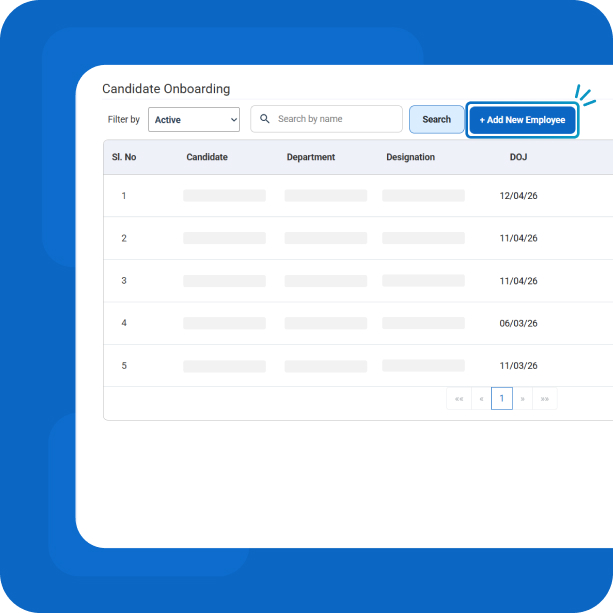
You set up the onboarding checklist once. After that, every time someone joins, you add their details, generate the kit, and track what has come in and what is still pending. Documents can be downloaded or shared directly with the employee from within the platform.

Nothing falls through because someone forgot to follow up. The status of every document for every employee is visible in one place.

7yrs

Minimum retention for onboarding records in India

Keep signed employment agreements, identity documents, PF and ESI records, and policy acknowledgements for at least seven years. This is the standard threshold for Indian labour law compliance and statutory audits.

Frequently Asked Questions

What does employee onboarding involve for Indian companies?
It covers offer letter signing, document collection, PF and ESI registration, tax documentation, and policy orientation. Doing this consistently from the start reduces the chance of compliance gaps and helps new employees settle in without confusion.
What documents are collected during onboarding in India?
The standard list includes Aadhaar or passport, address proof, educational certificates, relieving letters from the previous employer, PAN card, and bank account details. The exact set varies by company and role.
How does Offrd help with employee onboarding?
Offrd generates onboarding kits and tracks document collection for each new hire. The process is the same for every employee so nothing gets missed because someone was in a hurry that week. Used across India by companies that do not have a full HR department.
How much does onboarding cost on Offrd?
Pay-per-use starts at ₹99 per document. The subscription plan is ₹50 per active employee per month. New accounts get 50 free credits on signup.
Does Offrd handle PF and ESI registration during onboarding?
Offrd manages document generation and collection. For the actual statutory filings like PF and ESI, the platform supports the documentation side. Check directly with the Offrd team for current coverage on specific filings.
How long should onboarding documents be kept in India?
Seven years is the minimum to stay covered under Indian labour law. That includes employment agreements, identity documents, PF and ESI records, and signed policy acknowledgements.

Get every new hire through the same process

Set up your onboarding checklist once. Offrd handles the document side each time someone joins.

Start for Free Get Free Demo Now