Home Employee Exit Guide

Employee Exit Practices in India: Documents, Settlement and Legal Requirements

When an employee leaves, the paperwork matters as much as anything said in the exit interview. A relieving letter, an experience letter, and a properly computed full and final settlement are not optional courtesies. They are the documentary record of how the employment ended. Getting them right protects the employer, gives the departing employee what they need for their next role, and closes the relationship without loose ends.

Trusted by 4,000+ companies across India
What the Employee Exit Process Involves

The employee exit process in India covers a specific set of steps that should happen in sequence. Resignation is submitted and accepted, the notice period is served, exit clearance is completed across relevant departments, exit documents are issued, and the full and final settlement is processed. Each step has its own documentation requirement.

In practice, many companies collapse these steps or skip the documentation entirely. Verbal confirmations substitute for written letters. Final settlements get delayed because one department has not completed its clearance. Gratuity calculations are deferred or disputed. The result is rarely clean, and the consequences surface later, sometimes months after the employee has left.

The exit process also affects the employer's reputation in ways that are hard to quantify. A departing employee who does not receive their documents on time or whose final settlement is delayed talks about it. How a company handles the employee exit reflects directly on how it is perceived as an employer in a competitive hiring market.

  • Resignation submission and acceptance. The resignation should be in writing and the employer should issue a formal resignation acceptance letter confirming the last working day. A verbal acceptance without written confirmation leaves the last working date open to dispute, particularly if the employee later claims constructive dismissal or the employer disputes the notice period.
  • Notice period service or payment in lieu. The notice period is governed by the employment contract. Confirmed employees typically serve one to three months. If either party waives the notice period, the financial equivalent must be settled. Any waiver should be confirmed in writing to avoid disagreement about what was agreed.
  • Exit clearance across departments. IT, administration, finance, and the employee's direct function should each confirm that company assets have been returned, access credentials revoked, outstanding advances recovered, and pending work handed over. The final settlement is typically held until clearance is complete from all departments.
  • Issuance of exit documents. The relieving letter and experience letter should be issued on or close to the last working day, not weeks later. Employees joining a new company often cannot complete their onboarding without these documents, and delays create a reputational issue for the former employer.

Exit Documents Every Employer Should Issue

Each document serves a distinct purpose. Issuing one without the others leaves the exit record incomplete.

Resignation acceptance letter

This letter confirms that the employer has accepted the employee's resignation and states the agreed last working day. It is the starting document of the exit process. Without it, the notice period calculation has no fixed reference point, and the last working day remains a matter of verbal agreement. If the employee is serving a contractual notice period, this letter establishes when it began.

Relieving letter

The relieving letter is issued on the employee's last working day and confirms that they have been formally relieved of their duties and obligations. It states the last date of employment and that all exit formalities have been completed. Most companies and background verification agencies ask for a relieving letter when verifying prior employment. An employee who does not receive one is often unable to complete onboarding at their new employer.

Experience letter

The experience letter confirms the duration of employment and the role held. It is a factual document, not an appraisal or a character reference. It should state the joining date, the last working date, and the designation held. Some companies include a brief summary of responsibilities. The experience letter is separate from the relieving letter, though some employers combine both into a single document.

Full and final settlement statement

The settlement statement sets out every component of the final payment: salary for days worked, leave encashment, any unpaid incentives, pending reimbursements, and gratuity if applicable. It also records any recoveries such as advances or notice pay shortfall. This document is the financial quittance of the employment relationship. The employee should receive a copy alongside the final payment.

Full and Final Settlement

The full and final settlement, often referred to as FNF, covers every financial obligation between the employer and the departing employee. Each component should be calculated and documented separately.

  1. Salary for Days Worked in the Final Month

    Calculate the salary for the number of days actually worked in the last month of service. If the employee's last working day falls mid-month, the salary is prorated based on the number of calendar days or working days in that month, depending on the company's payroll convention. The method should be consistent with how the employment contract or payroll policy defines the daily rate.

  2. Leave Encashment

    Unused earned leave that has accrued and not been availed must be encashed at the time of exit. The rate is typically the basic salary divided by the number of working days in a month, applied to the number of unused leave days. Some states prescribe specific rules on leave encashment under their Shops and Establishments Acts. The employment contract should specify the encashment formula and any caps on carry-forward.

  3. Unpaid Bonuses and Incentives

    Any performance bonus or incentive that was earned but not yet disbursed at the time of exit should be included in the settlement, provided the eligibility conditions have been met. If the company's bonus policy requires the employee to be on the rolls on the date of disbursement, and they are not, that condition governs eligibility. The policy should be documented and communicated before the employee leaves to avoid a dispute later.

  4. Pending Expense Reimbursements

    Any work-related expenses incurred but not yet reimbursed must be settled. The employee should submit all pending claims before or on the last working day so the finance team can verify and include them in the final settlement. Claims submitted after the settlement is processed are administratively more difficult to handle and sometimes result in disputes about whether they were ever submitted.

  5. Recoveries and Deductions

    Any salary advance, company loan recovery, or notice pay shortfall where the employee did not serve the full notice period must be deducted from the settlement and listed explicitly. The recovery must be authorised under the employment contract or a written agreement signed by the employee. Undocumented deductions are difficult to defend if the employee raises a dispute before a labour authority.

  6. Gratuity, Where Applicable

    If the employee has completed five or more years of continuous service, gratuity must be calculated and included in the settlement under the Payment of Gratuity Act, 1972. For fixed-term employees, the New Labour Codes 2025 provide for proportional gratuity after one year of service. Gratuity is not subject to TDS up to the statutory limit prescribed under the Income Tax Act.

  7. TDS on Settlement Components

    Certain components of the final settlement attract TDS. Leave encashment above the statutory exemption limit is taxable. Salary for the notice period is taxable as salary income. Gratuity is exempt up to the statutory limit. The payroll team should calculate TDS correctly for the final month and ensure Form 16 for the year reflects the complete picture, including the exit settlement components.

Gratuity: Eligibility and Calculation

Gratuity is a statutory benefit governed by the Payment of Gratuity Act, 1972. It applies to establishments with ten or more employees. An employee is eligible for gratuity after completing five years of continuous service with the same employer. In cases of death or disablement, the five-year requirement is waived and gratuity is payable regardless of the duration of service.

Under the New Labour Codes 2025, which came into force in November 2025, fixed-term employees are entitled to proportional gratuity after completing one year of service. This is a significant departure from the previous five-year threshold for this category and affects how employers structure fixed-term arrangements.

Gratuity must be paid within thirty days of the date it becomes payable. An employer who delays payment beyond this period is liable to pay simple interest on the outstanding amount for the period of delay, unless the delay is attributable to the employee.

Gratuity formula under the Payment of Gratuity Act, 1972

Gratuity = (Last Drawn Basic + DA) × 15 × Years of Service ÷ 26
  • Five years of continuous service is the general threshold. Part of a year beyond five completed years is counted as a full year for the purpose of the gratuity calculation if the employee has worked for more than six months in that partial year.
  • The formula uses 26 as the denominator. This represents the number of working days in a month under the Act. The numerator uses 15, which represents fifteen days of salary per year of service. The last drawn basic salary plus dearness allowance is the base figure.
  • Gratuity is tax-exempt up to a statutory ceiling. Under the Income Tax Act, gratuity received from a covered employer is exempt up to the prescribed limit. Amounts above the ceiling are taxable as salary income in the year of receipt. The TDS calculation for the final settlement should account for this distinction.
  • Fixed-term employees now qualify after one year. Under the New Labour Codes 2025, employers using fixed-term contracts should factor proportional gratuity into their cost projections from the outset. The liability accrues from the first year of service and cannot be avoided by structuring the contract as fixed-term rather than permanent.
  • Gratuity cannot be forfeited except in specific circumstances. The Act permits forfeiture only if the employee's services are terminated for reasons involving moral turpitude or wilful damage to company property. A voluntary resignation or a standard performance-based termination does not give the employer grounds to withhold gratuity.
5yrs

Continuous service required for gratuity eligibility under the Payment of Gratuity Act, 1972

Five years is the general threshold for permanent employees. The New Labour Codes 2025 reduced this to one year for fixed-term workers, who are now entitled to proportional gratuity. In cases of death or disablement, the threshold is waived entirely and gratuity is payable regardless of tenure. Employers should factor this liability into every exit settlement where the tenure meets the applicable threshold.

Frequently Asked Questions

What documents does an employee receive when leaving a job in India?
An employee leaving a job in India should receive a resignation acceptance letter confirming the last working day, a relieving letter issued on the final day confirming they have been formally relieved of duties, and an experience letter confirming the duration of employment and role held. These three documents together constitute the standard exit documentation most future employers and background verification agencies ask for.
Is a relieving letter mandatory in India?
Indian law does not explicitly mandate a relieving letter, but the practice is so standard that most employers ask for one during the background verification process. Not issuing a relieving letter after an employee has completed their notice period and exit formalities puts the employer in a difficult position if the employee raises a complaint or if a future employer asks for confirmation that the separation was clean.
What is full and final settlement in India?
Full and final settlement is the process of settling all outstanding financial obligations between an employer and a departing employee. It includes the salary for days worked in the last month, leave encashment for unused earned leave, any unpaid bonuses or incentives, reimbursements for pending expenses, and gratuity if the employee has completed five years of continuous service. The settlement should be completed within the timeframe stipulated by the applicable state law or the employment contract.
How is gratuity calculated in India?
Under the Payment of Gratuity Act, 1972, gratuity is calculated as: (Last Drawn Basic Salary plus Dearness Allowance) multiplied by 15, multiplied by the number of completed years of service, divided by 26. The employee must have completed at least five years of continuous service, except in cases of death or disability. Under the New Labour Codes 2025, fixed-term employees are entitled to proportional gratuity after one year of service.
What is the notice period requirement in India?
The notice period is governed by the employment contract rather than a single central statute. Most Indian companies stipulate one to three months for confirmed employees. The probationary notice period is typically shorter, often one to two weeks. If either party wishes to waive the notice period, payment in lieu of notice is the standard arrangement. The terms must be in the original employment contract to be enforceable.
How does Offrd help with employee exit documents?
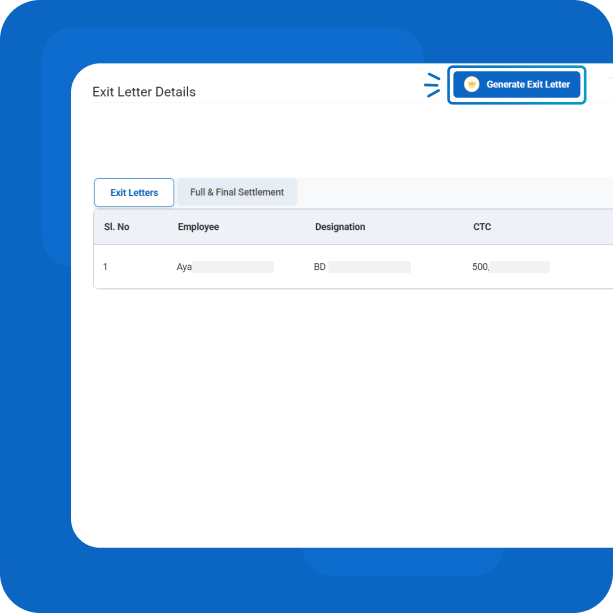
Offrd generates separation documents including experience letters and relieving letters from your configured template. You enter the employee details and last working day, and the platform produces consistent, formatted documents. Pay-per-use starts at ₹99 per document. The subscription plan is ₹50 per active employee per month. New accounts get 50 free credits on signup.

Issue every exit document correctly and on time

Relieving letters, experience letters, and separation documents, generated from one place the moment the exit is confirmed.

Start for Free Get Free Demo Now